Saturday, March 19, 2011

Internet, History

The History of the Internet has precursors that date back to the 19th century, especially the telegraph system. But the modern history of the Internet starts in the 1950s and 1960s with the development of digital computers. This lead to point to point communication between mainframe computers, continued on to star networks of terminals communicating with a single central computer, and to early research into packet switching. Packet switched networks such as ARPANET, Telenet, and the Merit Network were developed in the late 1960s and early 1970s using a variety of protocols. The ARPANET in particular lead to the development of protocols for internetworking, where multiple separate networks could be joined together into a network of networks.

In 1982 the Internet Protocol Suite (TCP/IP) was standardized and the concept of a world-wide network of fully interconnected TCP/IP networks called the Internet was introduced. Access to the ARPANET was expanded in 1994 when the National Science Foundation (NSF) developed the Computer Science Network (CSNET) and again in 1986 when NSFNET provided access to supercomputer sites in the United States from research and education organizations. Commercial internet service providers (ISPs) began to emerge in the late 1980s and 1990s and the Internet was commercialized in 1995 when NSFNET was decommissioned, removing the last restrictions on the use of the Internet to carry commercial traffic.

Since the mid-1990s the Internet has had a drastic impact on culture and commerce, including the rise of near instant communication by electronic mail (e-mail), text based discussion forums, and the World Wide Web. The research and education community continues to use advanced networks such as NSF's very high speed Backbone Network Service (vBNS) and Internet2. Increasing amounts of data is transmitted at higher and higher speeds over fiber optic networks operating at 1-Gbps, 10-Gbps, or more. The Internet continues to grow, driven by ever greater amounts of online information and knowledge, by commerce and entertainment, and by social networking.

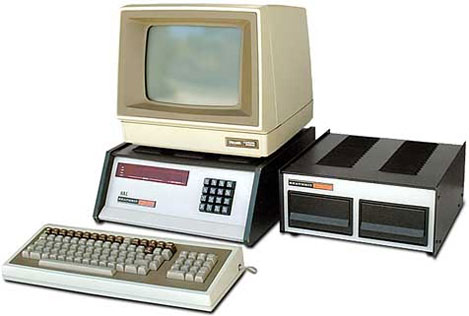
The Old Computer: Why We Still Love Them Read more


Vintage computers hold a certain novelty appeal, especially to those who have never seen one. An old computer hums with the history of modern progress, destined to be something more than just a giant paperweight.

In 1977, the first personal computer, the Apple II, was released to the mainstream. By modern standards, it is an archaic machine running on a one megahertz microprocessor and four kilobytes of RAM (Random Access Memory)-not even enough power to view a picture today.

To the masses of the 1970s, though, it was a window into the future; it was a device roughly the size of a small CRT (Cathode Ray Tube) television that bridged a post-moon-landing and technology-optimistic civilization-think Star Trek: The Original Series just ten years before and droves of science fiction paperbacks that filled shelves-to a dream of flying cars and a globe forever connected by a network of cables and invisible data waves.

Their dreams were partially correct. DARPA (The Defensive Advanced Research Projects Agency) collaborated with a number of scientists and professionals to introduce the Internet to the world's populace in the early 1990s, and we are now forever connected. Globally shared information can be accessed in almost any civilized region on Earth. People oceans away from each other can connect via this World Wide Web at the press of a button. The computer greats of the 1970s-Richard S. Stallman, Denis Ritchie, Steve Wozniak-had no idea how bright the future of technology, particularly computer technology, was going to be.

Yet, despite this astonishing advancement in computers, both software- and hardware-wise, there are still those who prefer to use vintage computers, such as the Apple II or the Commodore 64. It is a question that many ask and few understand: Why?

Old omputer gurus who remember what it was like to run an 8-bit system will often have kept their old computers through the years. Writing line after line of BASIC code on the green-on-black screen, a technology call a GUI (Graphical User Interface) that was originally thought of by Xerox for printers and faxes and then implemented in computers by Wozniak, holds a nostalgic value that old-school programmers cannot seem to shake. These antique computers are completely unable to function under the pressure of contemporary uses, but they are kept and used as reminders of a time when everything-including the computer-was much simpler.

Classic computers are not just kept as show toys or as vessels for nostalgic programmers to relive the glory days. They are also commonly used by novice engineering buffs, who use them as one would use a box of building blocks. They take these old computers apart and then put them back together again to learn the basics of computer hardware. Old computers are used because new computers would be too costly and difficult to practice on.


Old Computers


The concept of multiple machines is similar to the computers that existed long before that date. The first models of electronic computers were the size of a large room that draws significantly power of around 700 modern PCs.

Moreover, computers are now based on integrated circuits. They are a million times more powerful while only occupy a small space. Today, computers can be built small enough to fit on the clock. The battery is enough to make it work. Personal computers are also known icons in the information age and the sometimes confuse a computer, while computer more common today is what we call embedded computer.

Since the word integrity implies, this type of computer is a simple and very rarely used to control devices. In addition, computers are embedded in machines such as hunters, digital cameras, industrial robots, and toys for children.

Computers are versatile because they have the ability to perform as well as storage instructions, called
programs. They say the team is probably capable of performing the tasks that any other computer can do. This means that any kind either an individual or a super-computer can do the same computational tasks arising from or given to them because they have enough storage capacity.

How does a computer?

In general, ithas four sections, namely, the control unit, the ALU or arithmetic logic unit, and the I / O or
input and output devices. Groups son said bus interconnect all parties. The control unit of the ALU and the basic input / output with other computers that are closely related to the above products are known as the processor or CPU. Early versions of the CPU were made of several different elements, but since the 1970s, processors are usually constructed in a single integrated circuit called a microprocessor.

The control unit also known as a central controller and control system that manages other computer components.
Its primary method is to decipher or interpret one by one, all instructions in a program. Decode each set
Training and transformed into a sequence of signals that control the functions of computer parts. The
advanced control systems of equipment, probably in May to change part of the sequence of instructions
improve performance.

An important component of all CPUs is the special unit of memory or a register called the program counter. The call cons of the program keeps track of the memory location where you read the following instruction set.
The control system has several functions. One is to read the code of the next set of instructions the indicated cell, the program counter. Another feature is that decodes the digital codes instructions in a series of signals or commands for each system.